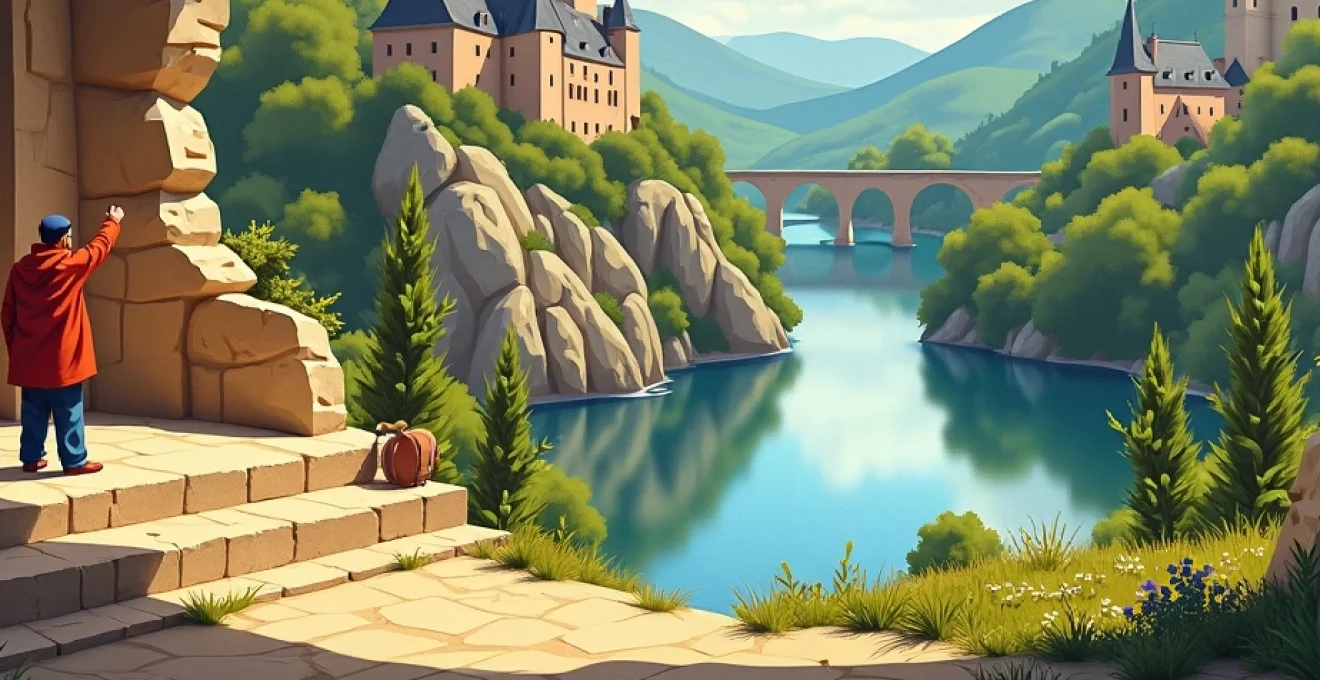
Nestled in the heart of southwestern France, the Dordogne Valley stands as one of Europe’s most extraordinary archaeological and cultural landscapes. This remarkable region, where prehistoric cave art meets medieval fortresses and gastronomic excellence, offers visitors an unparalleled journey through 400,000 years of human history. The valley’s unique combination of pristine natural beauty, world-renowned culinary traditions, and exceptional historical preservation makes it a destination that continues to captivate archaeologists, historians, and travellers from around the globe.
From the Sistine Chapel of Prehistory at Lascaux to the imposing cliff-top châteaux that guard the meandering Dordogne River, this region represents the very essence of France’s cultural heritage. The valley’s remarkable state of preservation, coupled with its UNESCO World Heritage designations, provides unprecedented insight into both prehistoric civilisation and medieval life. Whether you’re drawn to explore ancient cave systems, navigate the region’s waterways, or savour the world-famous Périgord cuisine, the Dordogne Valley offers experiences that are both intellectually enriching and deeply memorable.
Archaeological heritage and prehistoric cave systems of the dordogne
The Dordogne Valley’s archaeological significance cannot be overstated, representing one of the world’s most concentrated areas of prehistoric human activity. This remarkable region contains over 200 known archaeological sites, spanning from the Palaeolithic period through to the Iron Age. The limestone geology of the area has created ideal conditions for both human habitation throughout history and the exceptional preservation of organic materials, making it an invaluable resource for understanding early human development and artistic expression.
Lascaux cave complex and palaeolithic art preservation techniques
The Lascaux cave system, discovered in 1940, contains some of the finest examples of Palaeolithic art ever found, dating back approximately 20,000 years. The original cave houses over 600 painted and engraved animals, representing species that roamed the region during the last Ice Age, including horses, deer, aurochs, bison, and even some felines. The sophistication of these paintings, utilising natural rock contours to create three-dimensional effects, demonstrates the remarkable artistic capabilities of Cro-Magnon peoples.
Modern preservation techniques employed at Lascaux represent cutting-edge archaeological science. The original cave was closed to public access in 1963 due to deterioration caused by visitor breath and artificial lighting. Today’s visitors experience Lascaux IV, a full-scale replica that utilises advanced digital mapping and 3D printing technologies to recreate every detail of the original cave paintings. This facsimile employs the same pigments and techniques used by Palaeolithic artists, providing an authentic experience whilst protecting the irreplaceable originals.
Font-de-gaume cave polychrome bison paintings analysis
Font-de-Gaume represents one of the last caves in France where visitors can still view original prehistoric paintings in their natural setting. The cave contains more than 230 figurative depictions, with the polychrome bison paintings representing the pinnacle of Palaeolithic artistic achievement. These paintings, created using a sophisticated palette of red and black pigments derived from iron oxides and charcoal, demonstrate advanced understanding of colour mixing and artistic composition.
Recent analysis of the Font-de-Gaume paintings has revealed fascinating insights into Palaeolithic artistic techniques. Researchers have discovered evidence of preliminary sketching using fingers dipped in clay, followed by the application of pigments using both brushes made from animal hair and spray techniques achieved by blowing pigment through hollow bones. The artists demonstrated remarkable skill in utilising the cave’s natural contours, creating images that appear to move in flickering firelight.
Les Eyzies-de-Tayac UNESCO world heritage site excavations
Known as the Capital of Prehistory , Les Eyzies-de-Tayac serves as the epicentre of Dordogne’s archaeological significance. This small commune contains the highest concentration of prehistoric sites anywhere in the world, with ongoing excavations continually revealing new insights into early human behaviour and technological development. The area’s UNESCO World Heritage designation encompasses 147 prehistoric sites and 25 decorated caves, representing an unparalleled archaeological landscape.
Current excavation techniques employed at Les Eyzies represent the most advanced archaeological methodologies available. Teams utilise ground-penetrating radar, 3D digital mapping, and microscopic analysis to extract maximum information from every artefact discovered. Recent findings include evidence of sophisticated tool-making techniques, complex burial practices, and even early examples of musical instruments carved from bone, pushing back the timeline of human cultural development by several millennia.
Rouffignac cave mammoth engravings and visitor management systems
The Rouffignac cave system, known as the Cave of a Hundred Mammoths , contains the largest collection of mammoth representations in prehistoric art. These engravings, created over multiple periods spanning several thousand years, provide crucial insights into both the artistic traditions of different Palaeolithic groups and the megafauna that inhabited the region during the Pleistocene epoch. The cave’s 8-kilometre network of galleries represents one of Europe’s most extensive underground art galleries.
The preservation of these prehistoric masterpieces requires sophisticated environmental controls and visitor management protocols that balance public access with long-term conservation needs.
Modern visitor management at Rouffignac utilises an electric train system that minimises environmental impact whilst allowing access to the cave’s most significant artistic areas. Advanced monitoring systems continuously track humidity, temperature, and carbon dioxide levels, automatically adjusting ventilation to maintain optimal preservation conditions. This approach has become a model for sustainable archaeological tourism worldwide.
Medieval fortification architecture along the dordogne river basin
The Dordogne River basin contains one of Europe’s most impressive concentrations of medieval military architecture, with over 1,000 châteaux and fortified structures reflecting centuries of territorial conflicts between French and English forces during the Hundred Years’ War. These fortifications represent a remarkable evolution in military engineering, from early motte-and-bailey constructions to sophisticated Renaissance-era defensive systems. The strategic importance of the Dordogne River as a trade route and territorial boundary resulted in the development of an interconnected network of fortifications that could communicate and provide mutual support during times of conflict.
Château de beynac strategic Cliff-Top positioning and defensive mechanisms
Perched dramatically on a limestone cliff 150 metres above the Dordogne River, Château de Beynac represents the pinnacle of medieval strategic positioning. The fortress’s elevated location provided unobstructed views across 20 kilometres of river valley, enabling early detection of approaching enemies and rapid communication with allied fortifications. The château’s defensive design incorporates multiple layers of protection, including a barbican, drawbridge mechanisms, and murder holes that allowed defenders to pour boiling oil or shoot arrows at attackers.
The architectural evolution of Beynac spans six centuries, with each successive generation of owners adapting the fortification to counter contemporary siege techniques. The original 12th-century keep features walls over three metres thick, designed to withstand primitive siege engines. Later additions include sophisticated machicolations, carefully angled to provide maximum defensive coverage whilst minimising blind spots. The château’s domestic quarters, built during more peaceful periods, demonstrate the gradual transition from purely military structures to comfortable aristocratic residences.
Castelnaud-la-chapelle military engineering and siege warfare exhibitions
Château de Castelnaud houses Europe’s most comprehensive museum of medieval warfare, featuring reconstructed siege engines, authentic weaponry, and interactive demonstrations that bring medieval military technology to life. The castle itself exemplifies the evolution of defensive architecture, with modifications spanning from the 13th to the 17th centuries reflecting changing military technologies and tactics. The fortress’s position directly opposite Château de Beynac created a strategic confrontation point that defined regional politics for centuries.
The museum’s collection includes working replicas of trebuchets, mangonels, and other siege engines, demonstrating the sophisticated engineering capabilities of medieval military engineers. Visitors can witness live demonstrations of these massive machines, which could hurl 100-kilogram stones over 300 metres with remarkable accuracy. The exhibition also explores the development of gunpowder artillery and its revolutionary impact on castle design, illustrating how architectural innovation responded to technological advancement throughout the medieval period.
Château des milandes renaissance restoration techniques
The transformation of Château des Milandes from medieval fortress to Renaissance pleasure palace illustrates the dramatic social and architectural changes of the 15th and 16th centuries. Originally built as a military stronghold in 1489, the château underwent extensive modifications that replaced defensive features with ornate facades, expansive windows, and decorative elements that prioritised comfort and status over security. The castle’s association with Josephine Baker during the 20th century led to significant restoration efforts that employed both traditional craftsmanship and modern conservation techniques.
Contemporary restoration work at Milandes utilises advanced analytical techniques to understand original construction methods and materials. Specialist craftsmen employ traditional lime mortars, hand-carved stone replacement, and authentic roofing materials to maintain historical accuracy. The restoration project has become a training ground for traditional building skills, with master artisans passing on techniques for stone carving, timber framing, and decorative plasterwork that might otherwise be lost to industrial construction methods.
Domme bastide town urban planning and fortified gate systems
The bastide town of Domme, founded in 1281 by Edward I of England, represents a revolutionary approach to medieval urban planning that combined military defence with economic development. The town’s geometric layout, featuring a central marketplace surrounded by uniform building plots, maximised both defensive efficiency and commercial potential. Domme’s elevated position on a rocky promontory provided natural protection on three sides, requiring fortification only along the vulnerable northern approach.
The town’s three surviving gate systems demonstrate sophisticated defensive engineering that balanced security requirements with commercial accessibility. The Porte des Tours , the main entrance, features a double-gate system with massive round towers that could be independently defended if the outer gate was breached. Archaeological investigation has revealed evidence of complex gate mechanisms, including portcullises, drawbridges, and murder holes that created multiple defensive barriers. The integration of these military features with civilian infrastructure created a urban environment that was both defensible and commercially viable.
Périgord noir gastronomic terroir and agricultural production methods
The culinary heritage of Périgord Noir represents one of France’s most distinguished gastronomic traditions, built upon centuries of agricultural innovation and the unique ecological characteristics of the region. This area’s limestone soils, temperate climate, and diverse ecosystems create ideal conditions for producing some of the world’s most prized delicacies, including black truffles, foie gras, and walnut products. The agricultural methods employed in Périgord Noir combine traditional techniques passed down through generations with modern sustainable farming practices that preserve both environmental integrity and product quality.
The region’s truffle production, concentrated primarily around oak and hazelnut groves, represents a sophisticated symbiotic relationship between agriculture and forestry. Tuber melanosporum , the prized black truffle of Périgord, requires specific soil conditions and mycorrhizal relationships with host trees that take decades to establish. Traditional truffle hunters work with specially trained dogs or pigs to locate these underground treasures, employing techniques that have remained largely unchanged for centuries. The seasonal nature of truffle harvesting, typically occurring between December and March, creates an economic cycle that supports numerous local industries from hospitality to specialty food production.
Duck farming in Périgord Noir has evolved into a sophisticated agricultural system that produces both foie gras and confit, cornerstone products of regional cuisine. Traditional breeding methods emphasise free-range environments and carefully controlled feeding regimens that ensure optimal product quality whilst maintaining animal welfare standards. The production process requires considerable expertise, with farmers monitoring factors such as seasonal variations, feed composition, and processing timing to achieve the consistent quality that has made Périgord products world-renowned. This agricultural tradition supports numerous ancillary industries, including specialty packaging, preservation techniques, and artisanal food preparation methods.
The gastronomic traditions of Périgord Noir represent not merely culinary excellence, but a comprehensive agricultural philosophy that integrates environmental stewardship with economic sustainability.
Walnut cultivation in the Dordogne extends beyond simple nut production to encompass oil pressing, liqueur production, and timber harvesting from mature trees. The region’s walnut groves, many containing trees over a century old, require careful management that balances current production with long-term sustainability. Traditional oil pressing techniques, utilising millstones and hydraulic presses, produce walnut oil with distinctive flavour profiles that reflect both varietal characteristics and processing methods. The economic value of walnut products has encouraged the preservation of heritage varieties and traditional cultivation techniques that might otherwise be lost to industrial agriculture.
Dordogne valley canoeing routes and hydrological navigation systems
The Dordogne River system offers some of Europe’s finest recreational paddling opportunities, with over 500 kilometres of navigable waterways flowing through landscapes of exceptional natural beauty and historical significance. The river’s gentle gradient and reliable flow patterns create ideal conditions for canoeists of all skill levels, whilst its route through the heart of the Périgord region provides unparalleled access to châteaux, prehistoric sites, and traditional villages. The sustainable management of these waterways balances recreational access with environmental protection and the preservation of traditional river-based industries.
Navigation planning for the Dordogne requires understanding of seasonal flow variations, particularly during spring snowmelt periods and summer low-water conditions. The river’s flow is regulated by a series of upstream dams that maintain minimum water levels throughout the paddling season, typically extending from April through October. Professional outfitters provide detailed route planning that takes into account current conditions, skill levels, and desired stopping points at significant cultural or natural attractions. The most popular routes, such as the section between Vitrac and Beynac, offer spectacular views of cliff-top châteaux whilst maintaining manageable currents suitable for families and novice paddlers.
The hydrological characteristics of the Dordogne create diverse paddling environments, from wide, slow-moving sections ideal for wildlife observation to narrower channels where limestone cliffs rise directly from the water’s edge. Traditional stone weirs, known as barrages , require careful navigation but add historical interest to river journeys. These structures, originally built to power mills and control flooding, now serve as habitat for fish species and create the pool-and-riffle sequences that enhance both ecological diversity and paddling interest. Understanding these hydrological features allows paddlers to appreciate the river’s dual role as both a transportation corridor and an integral component of the region’s economic history.
Wildlife observation opportunities along Dordogne canoeing routes include sightings of kingfishers, herons, and the occasional otter, whilst riverside vegetation supports diverse bird populations throughout the year. The river’s excellent water quality, maintained through careful watershed management, supports healthy fish populations that attract both recreational anglers and wildlife enthusiasts. Sustainable tourism practices, including designated camping areas and waste management protocols, ensure that recreational use remains compatible with environmental conservation objectives. The integration of river-based recreation with cultural tourism creates economic opportunities for local communities whilst encouraging the preservation of both natural and historical resources.
Sarlat-la-canéda medieval urban conservation and stone masonry techniques
The medieval town of Sarlat-la-Canéda stands as one of Europe’s finest examples of urban heritage conservation, representing a remarkable achievement in balancing historical preservation with contemporary functionality. The town’s 14th and 15th-century architecture, constructed primarily from honey-coloured limestone quarried from local sources, creates an exceptional ensemble of medieval urban design that has remained largely intact despite centuries of political and economic change. The comprehensive restoration programme initiated in the 1960s pioneered conservation techniques that have since been adopted throughout France and beyond.
Traditional stone masonry techniques employed in Sarlat’s construction utilised local limestone varieties that provided both structural integrity and aesthetic coherence. The region’s geological characteristics produced stone with excellent working properties, allowing medieval craftsmen to create intricate decorative elements, complex vaulting systems, and sophisticated drainage solutions that continue to function effectively today. Modern conservation efforts require craftsmen trained in these traditional techniques, as contemporary materials and methods often prove incompatible with medieval construction systems. The town serves as a training centre for heritage crafts, ensuring that essential skills in stone carving, lime mortaring, and traditional roofing techniques are preserved for future generations.
The urban planning principles evident in Sarlat reflect sophisticated understanding of medieval commercial and social requirements. The town’s layout maximises the efficiency of the central marketplace whilst providing clear circulation routes and defensible boundaries. Building regulations established during the medieval period created architectural consistency whilst allowing for individual expression within established parameters. Contemporary conservation efforts must navigate the complex relationship between historical authenticity and modern building codes, particularly regarding accessibility, fire safety, and structural standards. This balance requires innovative solutions that preserve historical character whilst meeting contemporary functional requirements.
The success of Sarlat’s conservation programme demonstrates that heritage preservation can serve as a catalyst for economic development whilst maintaining cultural
integrity whilst serving as a dynamic example of sustainable heritage tourism.
The conservation methodology employed in Sarlat requires detailed documentation of existing structures before any intervention begins. Photogrammetric surveys, structural analysis, and materials testing provide comprehensive baseline data that guides restoration decisions. Craftsmen must understand the original construction sequence to ensure that repairs maintain structural integrity whilst preserving historical authenticity. The use of compatible materials, particularly lime-based mortars that allow stone to breathe naturally, prevents moisture damage that has compromised many heritage buildings elsewhere. This scientific approach to conservation has established Sarlat as a model for heritage preservation throughout the European Union.
The economic impact of Sarlat’s conservation success demonstrates the viability of heritage-led development strategies. The town’s exceptional preservation attracts over 1.5 million visitors annually, supporting numerous local businesses whilst maintaining residential communities within the historic core. This balance between tourism and authentic urban life requires careful management of visitor flows, parking provisions, and commercial activities that could compromise the town’s historical character. The success of this approach has influenced heritage policy throughout France, demonstrating that thorough conservation can serve as an engine for sustainable economic development in smaller urban centres.
The integration of modern infrastructure within Sarlat’s medieval fabric demonstrates innovative approaches to heritage conservation that preserve historical authenticity whilst meeting contemporary needs for accessibility and functionality.
Contemporary challenges in Sarlat’s ongoing conservation include climate change impacts on limestone structures, increasing visitor pressures during peak seasons, and the need to accommodate modern building services within historical constraints. Advanced monitoring systems now track environmental conditions within historic buildings, allowing preventive conservation measures that address problems before they become critical. The town’s conservation programme continues to evolve, incorporating new technologies such as non-invasive structural monitoring and advanced materials analysis whilst maintaining commitment to traditional craftsmanship and historical authenticity. This adaptive approach ensures that Sarlat’s remarkable medieval character will be preserved for future generations whilst continuing to serve as a vibrant, living community.