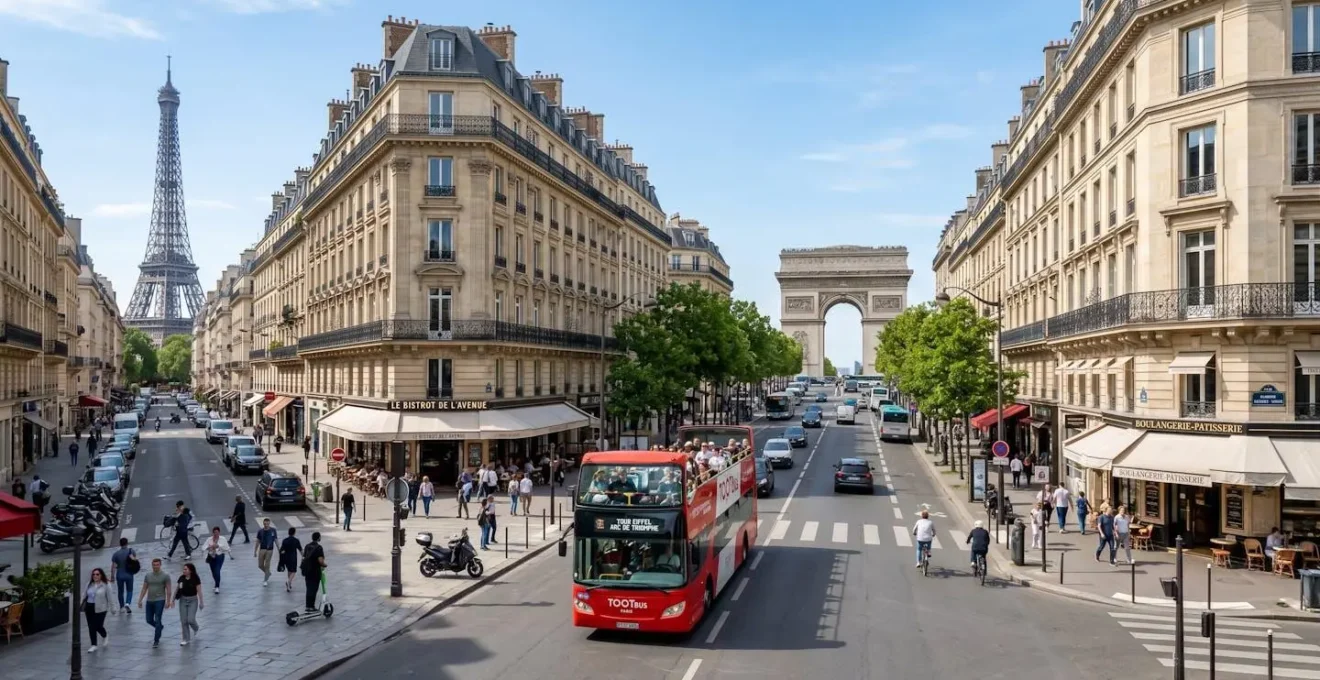
Choosing the right hop-on hop-off service in Paris can mean the difference between a seamless city discovery and hours lost waiting at bus stops or missing landmarks you travelled to see. With 6.4 million tourists visiting Greater Paris during summer 2025 alone, the competitive pressure on operators has driven genuine differences in pricing, technology and service quality—differences that directly affect your holiday experience and budget.
Four major options dominate the Paris sightseeing transport market: Tootbus, Big Bus Tours, Open Tour Paris, and the Seine-based Batobus alternative. While their core promise remains identical—flexible boarding to explore at your own pace—the practical realities of route coverage, bus frequency, family provisions and value for money vary considerably. A 48-hour pass can cost anywhere from €38 to €48 depending on operator, and documented price differentials of €4 to €13 separate the most competitive from the premium-priced services.
This comparative analysis examines verifiable data across six decision-critical criteria: pricing structures, route networks, technology integration, family experience, service frequency and accessibility features. The objective is straightforward—help you identify which operator genuinely matches your Paris itinerary requirements and budget constraints, rather than defaulting to brand recognition or the first search result.
Your 30-second Paris tour comparison snapshot
- Price leader: Tootbus delivers €4-€13 savings versus Big Bus on equivalent pass durations
- Tech innovation: AI guide answering questions in 50+ languages separates modern from traditional operators
- Family proposition: Dedicated children’s tours with age-appropriate audio commentary remain rare—only one operator offers both
- Service frequency: Larger fleets mean shorter waits, but route coverage matters more than bus quantity for landmark access
What makes a hop-on hop-off tour worth booking in Paris?
Not all hop-on hop-off services deliver equivalent value, despite marketing claims suggesting otherwise. The fundamental question isn’t whether this touring method suits Paris—it demonstrably does, which explains why operators collectively serve millions annually—but rather which specific service aligns with your practical requirements.
Three core factors separate genuinely useful services from mediocre alternatives. First, route coverage must match your must-see list, not just tick off generic landmarks. A service stopping 200 metres from the Louvre entrance differs substantially from one requiring a 10-minute walk with luggage or tired children. Second, pass validity periods need realistic alignment with your itinerary—purchasing a 24-hour pass for a three-day visit wastes money, whilst a 72-hour pass for a weekend break pays for unused access. Third, service frequency becomes critical during February half-term or August peak season, when a 12-minute average wait transforms into 30-minute gaps that consume your limited Paris time.
The principles of hop-on hop-off city exploration work brilliantly when operators maintain sufficient fleet capacity and intelligent stop placement. The system breaks down when you’re left shivering at Trocadéro in March drizzle, watching three full buses pass without stopping because smaller fleets can’t handle passenger volume during school holidays.
Technology integration now represents a fourth differentiator that didn’t exist five years ago. Real-time GPS tracking via mobile apps eliminates the guesswork from “when’s the next bus arriving?”, whilst AI-powered guides offer conversational responses to specific questions rather than pre-recorded commentary loops. Some operators have invested heavily in these features; others rely on legacy audio systems with eight language options and static route information.
According to Paris’s official tourism statistics, more than 37 million tourists visited Greater Paris in 2023, representing almost 24 million hotel arrivals. For first-time visitors especially—those without prior Paris navigation experience—hop-on hop-off services function as orientation tools first, transport second. The ability to complete a full circuit without disembarking, absorbing landmark context and geographical relationships, proves more valuable than any museum audioguide for subsequent independent exploration.
Paris hop-on hop-off operators compared: the definitive matrix
Transparent comparison requires like-for-like analysis across measurable criteria, stripping away marketing language to examine verifiable service specifications. The following breakdown covers four primary operators—Tootbus, Big Bus Tours, Open Tour Paris, and Batobus (Seine river alternative)—across pricing, routes, and technology features that materially affect user experience.
Pricing structures reveal where operators compete aggressively and where they rely on brand premium. As of January 2026, documented price differentials between equivalent pass types range from modest €1-€2 savings to substantial €10-€13 advantages depending on operator and pass duration. Tootbus positions itself as the value leader, with 24-hour passes priced approximately €1.80 below Big Bus’s equivalent offering, whilst 48-hour passes show a €5.10 differential. The gap widens considerably for combination products: hop-on hop-off plus Seine cruise packages demonstrate price differences reaching €10, and night tour combinations diverge by €13.20. These aren’t negligible amounts for families booking multiple passes—a family of four choosing a 48-hour hop-on hop-off plus cruise combination could save €40-€50 by selecting the most competitive operator over the premium-priced alternative.
Big Bus Tours maintains higher pricing across its product range, positioning on brand recognition and fleet size rather than cost competitiveness. Open Tour Paris occupies middle ground, neither cheapest nor most expensive, targeting visitors prioritising established French operator heritage over price sensitivity. Batobus operates a different model entirely. According to the operator’s official FAQ, its DUO LIBERTÉ pass combines 48 hours of Batobus Seine access with 48 hours of Big Bus land routes for 84 € (adults) or €49 (children aged 4-11). This represents premium pricing—€84 exceeds standalone 48-hour bus passes by €36-€46—but delivers 19 total stops (9 Seine waterfront plus 10 Big Bus land stops) including five shared stations enabling seamless river-to-road transfers.
All major operators cover core tourist landmarks—Eiffel Tower, Louvre, Notre-Dame, Arc de Triomphe, Champs-Élysées—but secondary coverage and stop proximity vary meaningfully. Route maps require close examination because “covers the Marais” can mean anything from a stop outside Place des Vosges to a distant Boulevard Beaumarchais location requiring a 12-minute walk. Big Bus Tours operates the most extensive land-based network, with systematic coverage of Right Bank and Left Bank districts plus dedicated stops for major museums. Its larger fleet enables route splits during peak periods, maintaining frequency even when passenger volume spikes.
Tootbus differentiates through themed route options alongside its core Discovery circuit. The “Hop-on with Emily” route targets fans of the Netflix series with filming location stops, whilst the dedicated Kids Tour follows child-friendly attractions with commentary designed for 4-10 year-olds. These niche routes won’t suit everyone, but for families with young children or pop culture enthusiasts, they represent genuine added value absent from competitors’ standardised offerings. Open Tour Paris maintains traditional four-route coverage (Paris Grand Tour, Montmartre-Grands Boulevards, Bastille-Bercy, and Montparnasse-Saint-Germain), providing depth in specific districts rather than broad thematic variation. For visitors focusing intensively on particular neighbourhoods—say, a deep dive into Montmartre’s artistic history—this granular coverage exceeds what general sightseeing circuits provide.
Batobus’s nine Seine stops prioritise waterfront landmarks and museum access (Musée d’Orsay, Louvre riverside entrance, Notre-Dame quays), offering unique perspectives but limited reach into districts beyond immediate riverbank proximity. Its full circuit without stops takes 1 hour 45 minutes, compared to Big Bus’s 2 hour 15 minute land circuit, making it faster for orientation loops but restrictive for comprehensive city coverage.
The technology gap between operators has widened substantially since 2023, separating those investing in user experience innovation from those maintaining legacy systems with minimal updates. Tootbus leads this category decisively with three integrated features: Tootie (an AI-powered guide responding to questions in over 50 languages), TootWalk (free audio-guided walking tours covering themes like Montmartre, fashion districts, and Emily in Paris filming locations), and real-time GPS bus tracking. The AI component represents a fundamental shift from pre-recorded commentary—passengers can ask conversational questions (“Why was Haussmann’s renovation controversial?” or “Where’s the nearest authentic crêperie?”) and receive contextual answers rather than waiting for scripted information loops.
Big Bus Tours provides a functional mobile app with real-time tracking and audio commentary in eight languages (including Korean and Chinese, valuable for Asian market visitors). The system works reliably but lacks conversational AI or supplementary walking tour content, positioning it as competent but not innovative. Open Tour Paris and Batobus offer more basic digital integration. Batobus’s webapp delivers audio commentary in five languages (French, English, Spanish, German, Italian) but doesn’t extend to GPS tracking or walking tour features. Open Tour relies primarily on onboard audio systems rather than app-based delivery, which eliminates smartphone dependency but reduces functionality for tech-comfortable users. For visitors without smartphones or those preferring traditional touring methods, simpler systems cause no disadvantage. For families wanting to occupy children with themed walking tours between bus segments, or international visitors needing responses in less common languages, the technology differential becomes decisive.
Evaluating these operators requires examining how pricing, routes, technology and family provisions combine to serve specific visitor needs. The following comparative matrix presents verifiable data across seven decision-critical criteria, enabling direct like-for-like assessment. Each criterion reflects measurable service specifications rather than marketing claims, covering factors from pass pricing through accessibility provisions. Understanding these differences helps match operator capabilities to your actual Paris touring requirements, whether you prioritise budget efficiency, minimal wait times, child-friendly content, or technological innovation.
The table below compares four operators across seven key criteria, from pricing to accessibility. Each row highlights verifiable differences that materially affect your Paris touring experience and budget.
| Criteria | Tootbus | Big Bus Tours | Open Tour Paris | Batobus (Seine) |
|---|---|---|---|---|
| Typical 24h pass price | €34-€36 | €36-€38 | €35-€37 | €22 (Seine only) |
| Typical 48h pass price | €38-€42 | €43-€48 | €40-€44 | €26 (Seine only) / €84 DUO with Big Bus |
| Route network | Multi-route including Emily in Paris theme, Kids Tour | Extensive land coverage, highest stop count | Four district-focused routes | 9 Seine waterfront stops (full circuit: 1h45) |
| Fleet size | Medium fleet | Largest fleet (shortest waits) | Medium fleet | Boat fleet (different model) |
| Technology features | AI guide Tootie (50+ languages), TootWalk audio walks, GPS tracking | App with GPS tracking, 8-language audio | Traditional audio system, limited app integration | Webapp audio (5 languages), no GPS tracking |
| Family-specific offerings | Dedicated Kids Tour, child audio commentary, family passes, seasonal kids events | Family passes, standard audio (no child version) | Family passes, standard audio (no child version) | Family passes, no child-specific content |
| Accessibility | Wheelchair-accessible buses, guide dogs unrestricted, free wifi | Wheelchair-accessible buses, standard provisions | Wheelchair-accessible buses, standard provisions | Wheelchair access on boats, limited capacity |
Where the real differences emerge: deep-dive analysis
Surface-level comparison reveals pricing and route variations, but three deeper factors determine whether a service genuinely suits your specific Paris visit or causes frustration that no discount compensates for.
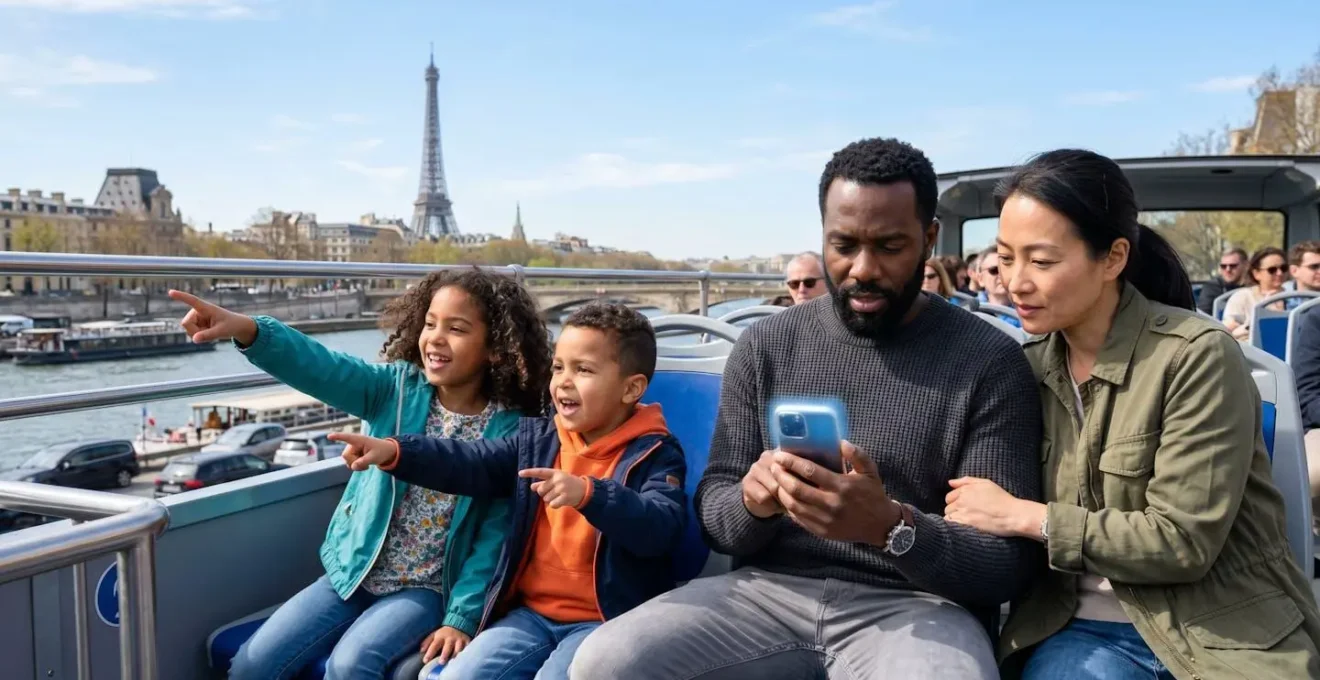
Every operator accepts children and offers family pass pricing, but the practical experience of touring Paris with a restless seven-year-old differs enormously depending on whether child-specific content exists or you’re subjecting young passengers to adult historical commentary for two hours. Tootbus stands alone in providing a dedicated Kids Tour with routes, timing and audio commentary designed for primary school age groups (4-10 years). The commentary replaces architectural dates and political history with interactive stories, treasure hunt elements and age-appropriate facts. During school holidays, seasonal variations appear—Halloween tours with spooky Paris legends, Christmas illumination circuits—that transform standard sightseeing into children’s entertainment.
This isn’t marginal detail for families. A typical scenario involves parents booking a 48-hour pass assuming their children will happily absorb two days of Napoleonic history and Haussmanian urban planning. Reality delivers complaints within 45 minutes, demands for phone games, and eventual abandonment of the service in favour of park visits and ice cream stops—rendering the pass a wasted expense. Big Bus Tours, Open Tour Paris and Batobus all welcome families but provide no child-specific audio alternatives. Children hear the same commentary as adults, relying on parental translation or entertainment. For short single-circuit orientation (60-90 minutes), this presents no major problem. For longer touring across multiple days, it significantly reduces value for families versus adult couples or solo travellers.
Marketing materials emphasise route coverage and pass duration but rarely specify the critical variable determining actual usability: how long you’ll wait between buses at each stop. Fleet size directly determines service frequency. Big Bus Tours operates the largest Paris fleet, translating to 10-15 minute intervals during peak season (April-October) and 15-20 minute waits during quieter months. This matters profoundly when you’re standing at Trocadéro with tired children in February drizzle—a 12-minute wait feels acceptable; a 28-minute wait in cold rain drives passengers toward metro alternatives and renders the flexibility promise hollow.
Tootbus and Open Tour Paris operate smaller fleets, with consequent impact on frequency. Expect 15-25 minute intervals during summer, stretching to 25-35 minutes in low season. For patient travellers planning stops around galleries and cafés—where you’ll spend 60-90 minutes before returning to a bus stop—this barely affects experience. For families with young children needing regular movement, or schedule-conscious visitors trying to fit multiple landmarks into limited time, longer waits compound into significant lost hours across a 48-hour pass. Batobus operates differently again, with boat departures every 20-25 minutes during high season, extending to 40-minute intervals November through March. The Seine’s linear route means you can’t easily “hop across” to different districts—movement is strictly riverbank to riverbank, making it complementary to land services rather than a complete substitute.
Market data from traveller reviews consistently highlights wait time frustration as a primary complaint for smaller-fleet operators during peak periods. One five-bus pass across three days theoretically offers excellent value; if you waste 90 cumulative minutes across those days standing in queues or at stops watching full buses pass without stopping, the time cost negates financial savings.
Open-top bus touring delivers magical experiences during May sunshine and brutal ordeals during February sleet storms. No operator can control Paris weather, but provision for adverse conditions separates thoughtful services from those leaving passengers soaked and miserable. All major operators provide covered lower-deck seating, but capacity limitations mean that during rain, everyone wants the covered seats simultaneously. Big Bus’s larger fleet handles this surge better through simple mathematics—more total buses means more covered capacity available across the network.
Tootbus mitigates weather vulnerability through its TootWalk audio tour feature. When rain renders open-top touring unpleasant, passengers can switch to guided walking tours of covered arcades, museum districts or indoor market areas without wasting their pass validity period. This flexibility transforms a weather-ruined day into an alternative exploration mode rather than a lost investment. Winter touring (November-March) requires realistic expectations about visibility, comfort and operating hours. Shorter daylight means less time for sightseeing, whilst cold temperatures make open-top exposure unpleasant beyond 20-30 minute segments. Night illumination tours gain appeal during winter—Paris’s Christmas lights and monument illuminations offset daylight limitations—but verify whether your chosen operator runs winter evening services before assuming year-round availability.
- Most competitive pricing (€4-€13 savings vs Big Bus across pass types)
- Leading technology integration (AI guide, audio walks, GPS tracking)
- Strongest family proposition (Kids Tour, child commentary, seasonal kids events)
- Themed route variety (Emily in Paris, fashion district tours)
- Smaller fleet than Big Bus (potentially longer waits during peak season)
- Less established brand recognition among first-time Paris visitors
- Largest fleet delivers shortest wait times (10-15 minutes peak season)
- Most extensive route network and stop coverage
- Established international brand with extensive review history
- Premium pricing (€4-€13 more expensive than value competitors)
- Limited technology innovation compared to AI-equipped alternatives
- No dedicated children’s tour or child-specific audio content
Route maps decoded: which operator covers what you actually want to see
Abstract statements like “covers major landmarks” provide no practical value when you’re deciding whether an operator genuinely serves your priority sites or forces compromises and supplementary metro journeys. Start by listing your non-negotiable landmarks—typically five to eight must-see sites that justify your Paris trip. For most UK visitors, this includes Eiffel Tower, Louvre, Arc de Triomphe, Notre-Dame (exterior viewing whilst restoration continues), and Sacré-Cœur. Secondary